Tool 03 · $12
Get it for $12
Score an ad before you spend a dollar on it.
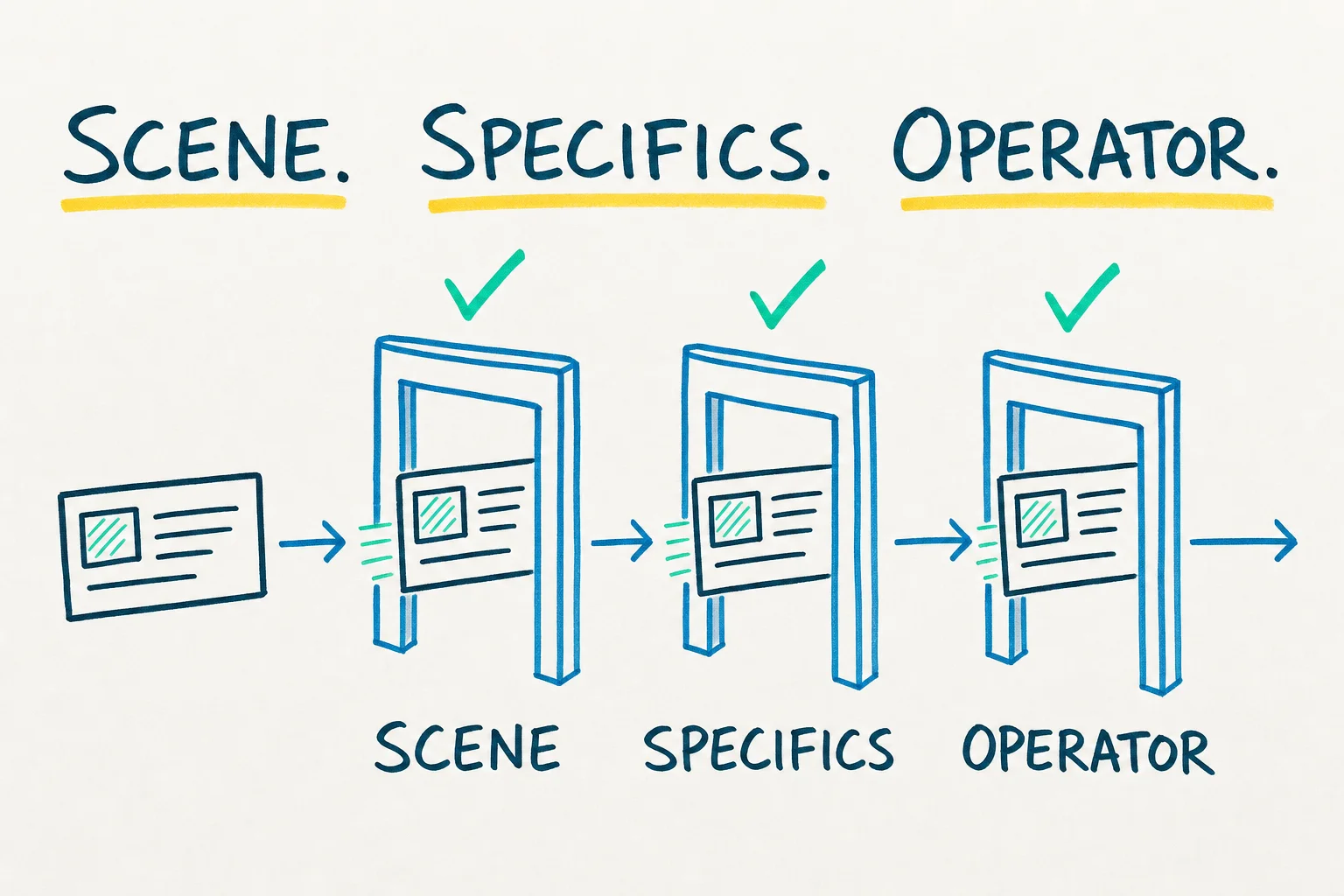
Three gates every ad passes before it runs: does it open in the buyer’s real scene, does it show concrete specifics, does it sound like an operator rather than a guru. Built from our own ad and Stripe data.
Once every payment carried its ad id (Tool 01), we had something nobody had shown us before: a list of our ads ranked by money that actually arrived.
We printed the top ten and the bottom ten and read them side by side. The pattern was not what we expected. The winners were not the cleverest or the most polished.
Every winner opened in a scene the buyer was already in: a Monday morning, a spreadsheet, a specific dashboard. Every winner had a number or a name in the first three lines. And every winner sounded like someone who does the work, not someone selling a course about it.
The losers failed at least one of the three. Most failed two. We turned the pattern into three gates and scored every new ad against them before it ran.
The three gates, the scoring and the examples are what this screen gives you.
Meta will happily spend your budget on any ad you give it. The feedback arrives a week later as a cost per result, by which time the money is gone and the next batch is already written.
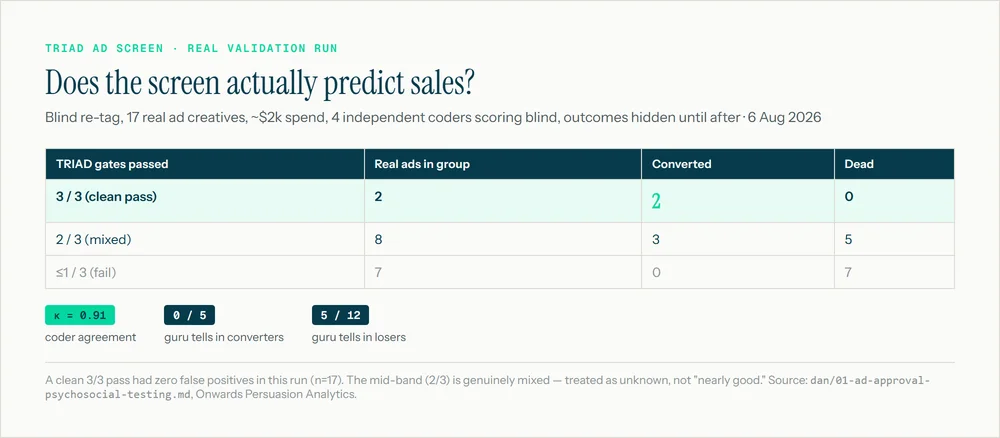
A screen moves the judgement to before the spend. It is not perfect. A screened ad can still lose. But an ad that fails a gate loses almost every time, and those are the ones you stop paying to test.
Three gates is deliberately few. More criteria means more arguing and fewer ads shipped.
Each gate is a yes or no with a one-line reason. An ad that fails any gate goes back for a rewrite or into the bin.
The scoring sheet asks one question per gate with a one-line reason. Takes two minutes per ad once you have done five. Good for a weekly batch review with a second person.
Paste the ad and the prompt scores all three gates, quotes the line that fails and suggests the rewrite. Same gates, same rules, ten seconds per ad.
Plus the guide itself: 6 pages on each gate, what passing looks like, and the common ways a good ad fails gate C without the writer noticing.
Your batch review has a filter. Every ad is scored before it gets budget, and the ones that fail go back for a rewrite instead of into the account.
After four weeks you have two lists: ads that passed and what they made, ads that failed and were never funded. The second list is money that stayed in your account.
This is step 2 of the sixty, between writing the ad and paying for it. Tool 01 tells you what each ad made. This tells you which ones to pay for at all.
Most agencies run the ads and rent everything else. Sixty Steps builds all sixty as real development on the client's own domain, then reports every week against what settled in Stripe.
These ten tools are the steps you can set up yourself in an afternoon. This one is step 2: the judgement between writing an ad and paying for it.

I built analytics models for banks and miners before this. The habit that stuck is not trusting a dashboard that grades its own work. Every tool on this page exists because we needed it on our own account first.
Dear reader,
If you have read this far, you have probably already decided whether $12 is a risk worth taking. It is less than one wasted day of ad spend. So the rest of this page is not about the screen. It is about who is selling it to you, and why we sell the steps one at a time.
We are an analytics firm that got into Meta ads by accident, found that nobody was measuring them properly, and started fixing that one step at a time. This is one of those steps.
My name is Ryan Richardson. For 6 years I built analytics models for banks and mining companies through a firm called Onwards Analytics. The brief was always the same: two systems that should agree do not, and someone senior needs to know which one to trust before the Monday meeting.
I had run Meta ads on and off for about five years. Once we ran them for our own offers, I was staring at the same problem I had been paid to solve for years, except now the two systems were Ads Manager and Stripe, and the person who needed to know was me.
So I did what I had always done. I traced every step between a stranger seeing an ad and a payment settling in Stripe, and wrote each one down. There were sixty. That list became a book called The Book Is the Funnel, and then a business called Sixty Steps that builds those steps for other people.
Three rules. We apply them to our own account before anyone else's.
Stripe is the scoreboard. Every report, decision and invoice is measured against money that settled. Platform dashboards are inputs. If a number on one of our pages cannot be traced to Stripe, it is marked as reasoning.
Everything lives on your domain, in your name. Pages, checkout, email and tracking are real code you own. There is no page-builder licence, and nothing stops working if you stop working with us.
We use it before we sell it. Every ad we run passes the three gates first. The worked examples are our own ads, with our spend replaced by brackets.
That is also why the screen is $12. We are not trying to make money on it. We are trying to stop you funding ads that fail a gate, because that is where most small accounts lose their first thousand dollars.
Each tool is one step from the book, packaged as the exact files we use: a template, a sheet, a script outline or a prompt, plus a short guide. They cost between $4.95 and $27. There is no software to subscribe to and nothing that phones home.
Three of them measure. One tags each Stripe payment with its ad. A weekly review joins those tags to Meta results and tells you what to make next. A six-lever diagnostic scores your whole funnel and finds the weak one.
Two of them screen. A three-gate scoring sheet judges an ad before it costs money. A blind panel of AI buyers scores the same ad independently and reaches a consensus.
Two of them research. One maps how your top 10 rivals look and where the empty space is. One pulls any competitor's ads and ranks them by how long they have run.
Three of them build. 40 ads uploaded from one spreadsheet. A landing page that tests its own variants against purchases. A pipeline that produces 20 scored offers in an afternoon.
None of them replaces the other fifty steps. Each one makes one step faster, or makes one number honest. This page sells the screen, because the cheapest ad is the one you never paid to test.
The files arrive by email within a few minutes. You open the sheet, score your current ads, and see which gate they fail. The failures go back for a rewrite before they get budget.
Then nothing happens. There is no onboarding sequence, no upsell call, no countdown. If you want the other tools you will find them on the site. If you want us to build the rest of the sixty steps for you, the site explains how that works and what it costs, and it starts with a free teardown that might say no.
If the screen does not do what this page says, reply to the receipt email and say so, any time in the first 60 days. You will get your $12 back and I will want to know what went wrong.
P.S. Gate C is the one most writers fail without noticing. Read your last ad out loud and ask whether the person speaking does the work or sells a course about it.