Tool 02 · $7
Get it for $7
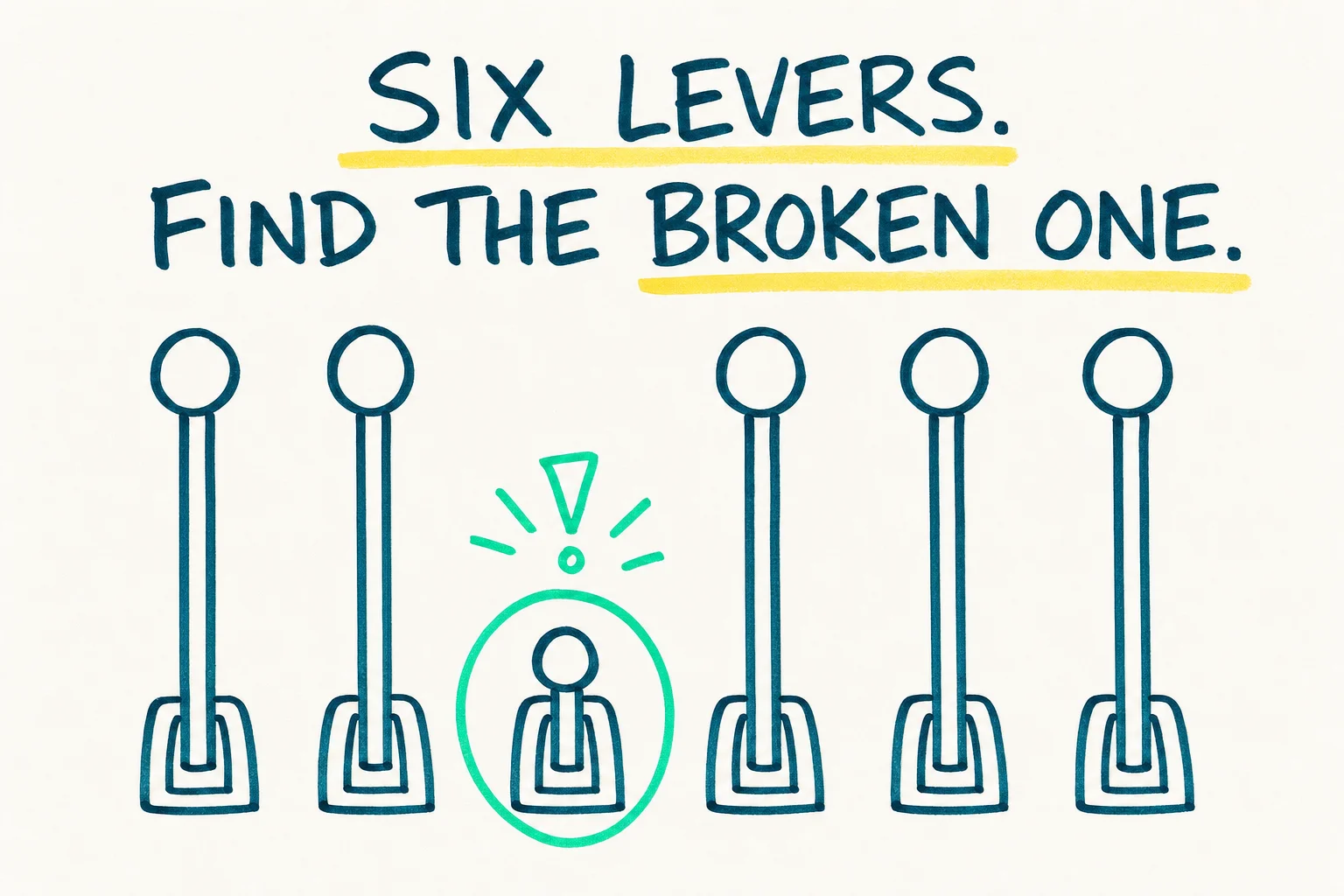
Find the one lever holding your funnel back.
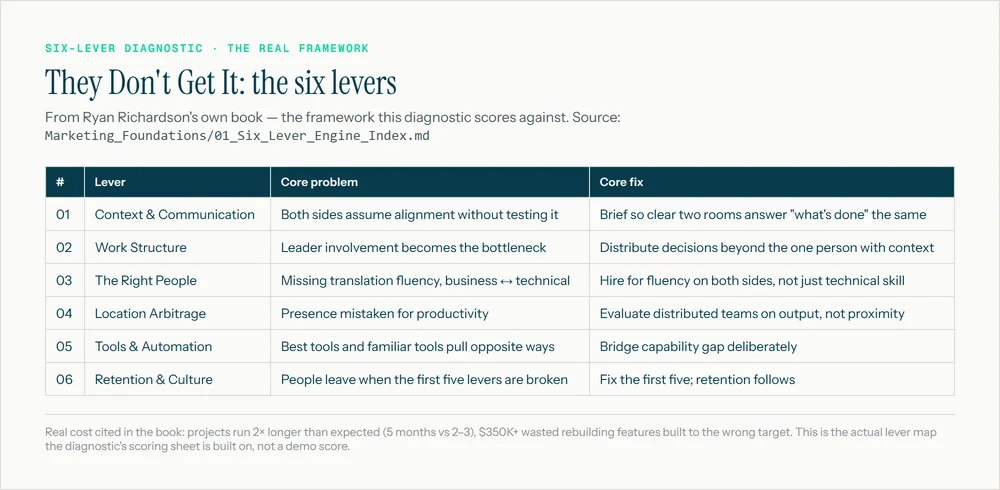
Score six levers, find the weakest, fix that one first. A self-diagnosis from Ryan's book They Don't Get It, with a Claude prompt that runs it for you.
Our own funnel, one quarter. Cost per sale had climbed for three weeks. The obvious move was new creative, so we made new creative. Twice.
Nothing changed. Then I did what I would have done for a bank: stopped touching things and scored the whole system instead. Offer, traffic, page, price, proof, follow-up. Six levers, one to ten each.
Five of them scored seven or above. The page scored a three. People were clicking, reading, and leaving before the buy button. The ads had been doing their job the whole time.
We fixed the page in an afternoon. Cost per sale came back down. The three rounds of creative had cost us money and fixed nothing.
The six levers and the scoring are what this diagnostic gives you, on one sheet, in about 20 minutes.
New creative lifts click-through. A new price lifts conversion for a week. A new audience lifts reach. Each one produces a number that goes up, so each one feels like progress.
A funnel only grows as fast as its weakest lever lets it. Lift any of the other five and the weak one quietly caps the result. You see a bump, then the same ceiling.
The diagnostic exists to find the ceiling before you spend another week lifting something else.
Twenty minutes with the sheet, or ten with the prompt. You end with one lever named and one fix to make this week.
Plus the guide itself: 3 pages explaining each lever, what a 3 looks like against an 8, and the fix we reach for first at each one.
You have one lever named and one fix to make. Everything else on the to-do list waits a week, because the map says it will not move the result.
Next Monday you re-score. If the weak lever came up, a different one is now the lowest, and that becomes the week’s work. The funnel grows one lever at a time, in the right order.
This is step 4 of the sixty: the first decision after the ads are live. Every build we do for clients starts with this sheet.
Most agencies run the ads and rent everything else. Sixty Steps builds all sixty as real development on the client's own domain, then reports every week against what settled in Stripe.
These ten tools are the steps you can set up yourself in an afternoon. This one is step 4: the first honest look at the whole chain after the ads are live.

I built analytics models for banks and miners before this. The habit that stuck is not trusting a dashboard that grades its own work. Every tool on this page exists because we needed it on our own account first.
Dear reader,
If you have read this far, you have probably already decided whether $7 is a risk worth taking. It is not much of one. So the rest of this page is not about the diagnostic. It is about who is selling it to you, and why we sell the steps one at a time.
We are an analytics firm that got into Meta ads by accident, found that nobody was measuring them properly, and started fixing that one step at a time. This is one of those steps.
My name is Ryan Richardson. For 6 years I built analytics models for banks and mining companies through a firm called Onwards Analytics. The brief was always the same: two systems that should agree do not, and someone senior needs to know which one to trust before the Monday meeting.
I had run Meta ads on and off for about five years. Once we ran them for our own offers, I was staring at the same problem I had been paid to solve for years, except now the two systems were Ads Manager and Stripe, and the person who needed to know was me.
So I did what I had always done. I traced every step between a stranger seeing an ad and a payment settling in Stripe, and wrote each one down. There were sixty. That list became a book called The Book Is the Funnel, and then a business called Sixty Steps that builds those steps for other people.
Three rules. We apply them to our own account before anyone else's.
Stripe is the scoreboard. Every report, decision and invoice is measured against money that settled. Platform dashboards are inputs. If a number on one of our pages cannot be traced to Stripe, it is marked as reasoning.
Everything lives on your domain, in your name. Pages, checkout, email and tracking are real code you own. There is no page-builder licence, and nothing stops working if you stop working with us.
We use it before we sell it. We score our own funnel with this sheet every month. The example scores in the guide are ours, with the figures replaced by brackets.
That is also why the diagnostic is $7. We are not trying to make money on it. We are trying to get you to stop fixing the wrong thing, because that is the mistake we see most and it is the cheapest one to prevent.
Each tool is one step from the book, packaged as the exact files we use: a template, a sheet, a script outline or a prompt, plus a short guide. They cost between $4.95 and $27. There is no software to subscribe to and nothing that phones home.
Three of them measure. One tags each Stripe payment with its ad. A weekly review joins those tags to Meta results and tells you what to make next. A six-lever diagnostic scores your whole funnel and finds the weak one.
Two of them screen. A three-gate scoring sheet judges an ad before it costs money. A blind panel of AI buyers scores the same ad independently and reaches a consensus.
Two of them research. One maps how your top 10 rivals look and where the empty space is. One pulls any competitor's ads and ranks them by how long they have run.
Three of them build. 40 ads uploaded from one spreadsheet. A landing page that tests its own variants against purchases. A pipeline that produces 20 scored offers in an afternoon.
None of them replaces the other fifty steps. Each one makes one step faster, or makes one number honest. This page sells the diagnosis, because a fix in the wrong place is the most expensive thing in advertising.
The files arrive by email within a few minutes. You open the sheet, pull last month’s numbers, and score the six levers. By the end you have one lever named and one fix for this week.
Then nothing happens. There is no onboarding sequence, no upsell call, no countdown. If you want the other tools you will find them on the site. If you want us to build the rest of the sixty steps for you, the site explains how that works and what it costs, and it starts with a free teardown that might say no.
If the diagnostic does not do what this page says, reply to the receipt email and say so, any time in the first 60 days. You will get your $7 back and I will want to know what went wrong.
P.S. The most common result from people who run this sheet is relief. The thing they have been rewriting for a month was fine. Something they had not looked at was the problem.